
| Fact | Detail |
|---|---|
| Solo support | Confirmed — official description supports solo play |
| Party required | No — but no published scaling rules; confirm per dungeon |
| Best solo class | Unverified — no complete class ranking exists yet |
| Method below verified | August 2026 |
| Core principle | A finished run beats a failed fast attempt |
How do I pick a solo-ready difficulty?
Choose from the difficulties the selector actually displays for your character — public walkthroughs confirm multiple named difficulties but not every unlock level or reward count. Then run the three-run test before calling a difficulty farmable:
- Do01
Run one — learn the route
Establish the room sequence and boss position. Do not judge rewards yet.
- Do02
Run two — change one thing
Fix only the biggest bottleneck from run one: a slot swap, a different ability, a tighter pull.
- Do03
Run three — confirm it repeats
If the improvement holds, the difficulty is yours. One lucky drop or clean dodge string proves nothing.
Match the failure to the fix before moving up or down:
| Result | Likely bottleneck | Next move |
|---|---|---|
| Fail in normal rooms | Threat control or survival | Shorten attacks, create space, or drop a difficulty |
| Boss reached late | Room damage or route efficiency | Improve area coverage, remove backtracking |
| Boss survives the timer | Single-target uptime | Use safer damage windows and a boss-suited slot |
| Random deaths | Unstable positioning | Lower risk until three clears are controlled |
How do I control rooms alone?
Solo, every enemy pressures the same character — you. Enter far enough to see the whole group, keep the camera on the largest danger, and never surround yourself. Pull enemies into ground that leaves at least one escape direction open. If a long ability locks you in place, cast it only after a clear telegraph window or once enemies are safely grouped.
Prioritize threats by what disrupts the run: ranged attackers that force constant movement, fast enemies that close your escape space, and durable targets that keep a room alive. Classify enemies by behavior during the run rather than trusting an old wiki roster — exact names vary by dungeon.
And do not dump every ability the instant it is ready. Keep one reliable answer for the next group or an emergency unless the cooldown clearly returns in time. Solo consistency comes from always having an option when the room gets messy.
How do I read bosses without a party?
At a new boss, stop maximizing damage. Watch one full cycle — cue, danger area, movement requirement, recovery — then fit one short attack after each move. Repeat until the response is automatic, and only then add damage that does not remove your escape.
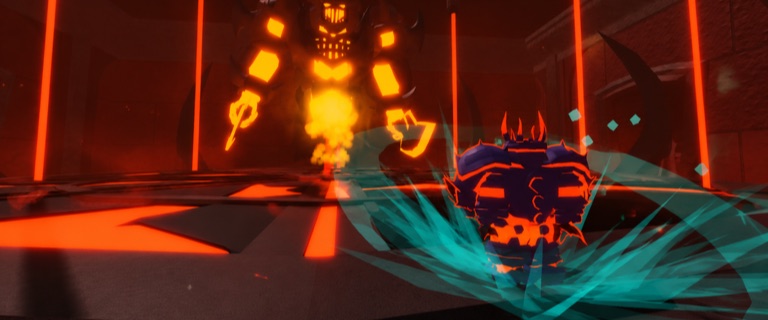
If the boss changes behavior, treat it as a new phase: recenter the camera, re-establish safe range. Never chase through an attack because the health bar is low — a failed clear costs more time than one missed opening. Desert Temple's Sand Giant is the community-standard first boss for practicing exactly this.
How do I balance damage and survival?
Fix the current failure, not a theoretical one. Dying in normal rooms means survival and movement outrank peak damage. Surviving comfortably but timing out means improving damage you can actually apply. Abilities missing mobile targets means changing placement or picking a reliable option — not chasing a bigger tooltip number.
Change one slot at a time on the same route, and record room-clear pace, boss attempts, avoidable hits, and completion. Use current item labels only — no original Dungeon Quest stat table is assumed here.
Recovering from a failed run
Name the exact failure point: room, enemy behavior, boss cue, timer, or equipment mismatch. If you cannot name it, rerun the same difficulty and observe. If you can, make the smallest relevant change. Dropping a difficulty is not lost progress — a lower tier you finish repeatedly beats a higher tier you fail. And never reach for scripts or auto-farm tools to bypass the route; they risk the account (see the script status page).
Is every Dungeon Quest Reborn dungeon soloable?
The official description supports solo play generally, but no verified source establishes every dungeon/difficulty combination or scaling rule. Test the displayed route with your current gear.
What is the best solo class?
Unverified — no complete current class ranking exists. Choose items and abilities whose displayed behavior gives you reliable room coverage, boss damage, and survival.
Is solo slower than playing with a party?
Co-op clears are generally faster and more forgiving while learning. Solo gives you clean feedback — every mistake is yours — which makes it the better teacher for routes and bosses.
Do I get less loot playing solo?
To be confirmed — no verified source publishes solo versus party loot rules for the current build. Compare your reward screens across runs rather than trusting claims.